


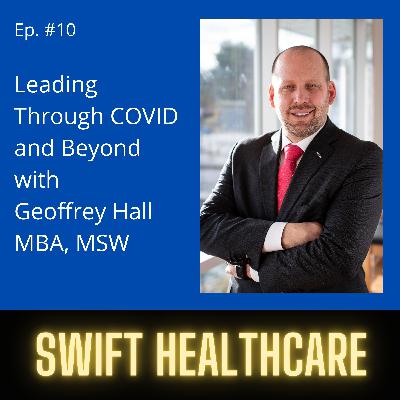
10. Leading Through COVID & Beyond w/ Geoffrey Hall MBA, MSW
Description
In this episode, we discuss courage and humility as essential for leading through a pandemic and beyond in order to save lives and honor your staff. Geoffrey Hall MBA, MSW has more than 20 years’ experience in Healthcare Administration and earned his MBA in Management and Operations from Walden University, a Master of Social Work from East Carolina University, and a Bachelor of Social Work from Auburn University. Geoffrey joined the Cleveland Clinic Rehabilitation Hospital system in October, 2016 and currently serves as the Chief Executive Officer for the Cleveland Clinic Rehabilitation Hospital, Edwin Shaw located in Akron, Ohio. Prior to this position, Geoffrey served as the Administrator for the nationally ranked Rusk Rehabilitation as part of the NYU Langone Health system from 2009 – 2016.
Geoffrey Hall MBA, MSW on LinkedIn
https://www.linkedin.com/in/geoffrey-hall-1988265a
Music Credit:
Jason Shaw from Audionautix.com
THE IMPERFECT SHOW NOTES
To help make this podcast more accessible to those who are hearing impaired or those who like to read rather than listen to podcasts, we’d love to offer polished show notes. However, Swift Healthcare is in its first year.
What we can offer currently are these imperfect show notes. The transcription is far from perfect. But hopefully it’s close enough - even with the errors - to give those who aren’t able or inclined to learn from audio interviews a way to participate. Please enjoy!
[00:00:00 ] Patrick Swift PhD, MBA, FACHE: [00:00:00 ] Welcome folks to the Swift healthcare video podcast.
[00:00:03 ] Thank you for joining. I am delighted with our guests that I have for you. I believe this is a very special treat and a dear colleague and friend of mine I've known for, for 10 plus years. And I want to welcome to the show. Geoffrey Hall, Geoffrey. Welcome to the show.
[00:00:18 ] Geoffrey Hall, MBA, MSW: [00:00:18 ] Thank you very much.
[00:00:19 ] Patrick Swift PhD, MBA, FACHE: [00:00:19 ] Hey, I'm glad you're here. And folks, let me read you a bio for Jeffrey, and I think you're gonna enjoy this.
[00:00:25 ] Jeffrey Hall has more than 20 years of experience in healthcare administration. Jeffrey obtained an MBA in management and operations from Walden university. A master of social work from East Carolina university and a bachelor of social work from Auburn university to hear the thread of heart in the work that he does.
[00:00:42 ]He joined the Cleveland clinic rehabilitation hospital system in October, 2016, and currently serves as the chief executive officer for the Cleveland clinic rehabilitation hospital, Edwin Shaw, located in Akron, Ohio. Go Ohio prior to this position, Jeffrey served as the administrator for the nationally ranked Rusk rehabilitation as part of the NYU Langone health system from 2009 to 2016.
[00:01:07 ]And, uh, as a dear personal friend of mine, . I have traveled the world with Jeff. We haven't gone to China. We've gone to Qingdao and long Joe in Beijing and, and touch many lives. And. Moved education, health, education, medical education forward, and Jeffrey with all my heart.
[00:01:24 ] Welcome to Swift video podcast. Okay.
[00:01:26 ] Geoffrey Hall, MBA, MSW: [00:01:26 ] Thank you, Patrick. That was quite the introduction.
[00:01:29 ] Patrick Swift PhD, MBA, FACHE: [00:01:29 ] Well, there's a lot of love there. Right, right, right, right.
[00:01:32 ] Geoffrey Hall, MBA, MSW: [00:01:32 ] Absolutely.
[00:01:33 ]Patrick Swift PhD, MBA, FACHE: [00:01:33 ] So our episode for today, we are looking at leading through COVID and beyond if I had a sound effect, I would. Tied in, right. They're leading through COVID and beyond . Let's talk about this.
[00:01:46 ]Geoffrey Hall, MBA, MSW: [00:01:46 ] I would start by saying that, , certainly 2020 was probably one of the most interesting and maybe personally the most challenging years as a healthcare executive that I can remember and, I think you have to look back to how this pandemic started in end of February, early parts of March, and just the uncertainty and the, the prevailing sense of, of dread and even fear.
[00:02:10 ] , I remember just the one-on-one conversations with my frontline caregivers, nurses, therapists, doctors, , as well as our, our leadership team. And there's just so much uncertainty and so much unknown as, as COVID really started to kind of spread across the world. And I know here in our Cleveland, , Ohio area, , in the,
[00:02:32 ] partnership with Cleveland clinic. the entire region was just preparing for this massive surge of patients that looked like it was going to, at that time overwhelm the local hospital system, there was not going to be enough beds. There was not going to be enough caregivers. the Cleveland. Clinic itself was, , Decommissioned their state-of-the-art health education building, which is their newest building on their main campus and started to build a thousand bed field hospital.
[00:02:58 ] The convention center here in Akron was being turned into a field hospital and, , my location, , being primarily a rehab location was told, , that we were going to become a surge site and, , You know, that was a change in scope and change of focus and change of service line for us. And, , that decision was communicated to me just after five o'clock on one day.
[00:03:20 ]And I was told I needed to put together an emergency plan over 24 hour period. So, you know, leaving work after what is normally a long day, , went home and worked on this plan, , till at least midnight and, By midnight, we had, I had pulled together almost a 50 page plan of how I was going to change my building, into a COVID hospital.
[00:03:43 ]And, , communicating with my medical director, communicating with my leadership team. and then the next day, , 24 hours passes and I was told to kind of stand down. We're not going to do that. , We're we're, we're not, this is just a model. Let's, let's think this through. And then about three days later, , I got another call back from regional leadership and said, , not only do we need to stand this up, but how fast can you stand this up?
[00:04:07 ]And from that moment, I think the clock started and I had about seven days to alter my building through construction, creating new patient and staff entrances and entire new workflow processes. And how was I going to create a closed and segregated COVID unit that would not mix with my other caregivers and my other rehab patients.
[00:04:31 ], and then that plan had to be scalable depending on the size of the surge. It was a really dynamic time because when we were still as, as a community, learning about COVID and what were the risk factors? And this is before, you know, some of the lockdowns occurred. Some of the mask requirements occurred long before there was a vaccine on the horizon.
[00:04:53 ]so there was a lot of uncertainty and I was very proud of my team because we, we did stand up a COVID unit. , , in that short period of time, we built walls. We've changed workflow processes. , and we went from a place of uncertainty and.
[00:05:08 ] Patrick Swift PhD, MBA, FACHE: [00:05:08 ] for safety, right?
[00:05:09 ] Geoffrey Hall, MBA, MSW: [00:05:09 ] Yeah, we built physical walls, , for safety as, as a way to, , you know, really create distinct care areas.
[00:05:16 ], and of course, PPE and, you know, moving everybody into and 95 masks and all of the, the requirements that we've all heard about. So we did that in just over seven days. And then we started to admit, , COVID positive patients. , and we were one of the first rehab hospitals, , within our company.
[00:05:36 ]certainly our region that started to admit COVID patients and COVID recovery patients. And that really, , Changed our model and it kind of brought back this crystal focus on total care of the patient. And one of the unique things that we did, and I actually took away as a, as a best practice, if you will, is we aligned our nursing and therapy schedules to two identical 12 hour shifts and we made.
[00:06:03 ]Patient assignments as a team. And what was really unique in that is you had nurses, helping patients, , do their physical therapy exercises and get stronger. And you had speech therapist helping with bedside commodes and, you know, the toileting needs of patients. And it was less about your discipline and more focus on what does this patient need to get better and get stronger.
[00:06:28 ] And as a result, , the outcomes of this unit was so impressive. We had zero acute or emergent send-outs. We had zero patient falls. We had a hundred percent of our patients discharged home. , the gold standard for most rehab hospitals is about three hours of therapy per day, , which is pretty intensive.
[00:06:50 ] And in the early weeks of this unit, some of our patients, because. , they turned that corner with COVID and suddenly started to rapidly improve after these long hospitalizations, they were getting four or five hours of therapy a day because the team, again, around, around this total care, , was just really focused on creating great patient outcomes.
[00:07:10 ]And, you know, there were so many unique heartfelt moments around this because my staff went from a place of fear and. We don't know anything about this. We're, we're scared, you know, how are we going to be protected and how we're going to be safe? And that unit was formed with a hundred percent volunteers, nurses, therapists, housekeepers, , case managers, everybody that went on that unit volunteered for that duty.
[00:07:34 ] Um, and we're really at the tip of the yeah.
[00:07:37 ] Patrick Swift PhD, MBA, FACHE: [00:07:37 ] I'm sorry if I may ask, how did you do





 United States
