


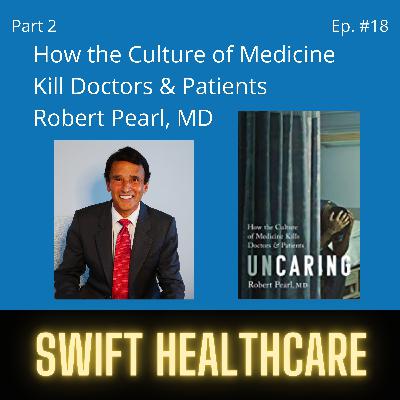
18. (Part 2) Uncaring: How the Culture of Medicine Kills Doctors & Patients w/ Robert Pearl, MD
Description
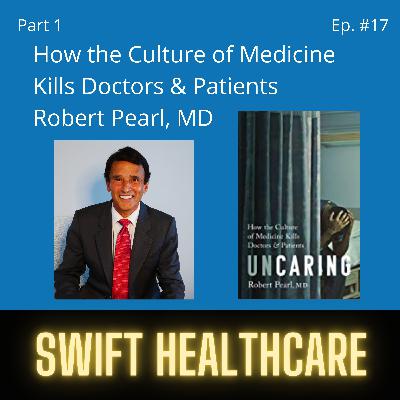
Part 2 - Uncaring: How the Culture of Medicine Kills Doctors & Patients w/ Robert Pearl, MD.
Tune into Swift Healthcare Podcast to hear Robert Pearl, MD discuss his new book which has already become a #1 New Release in multiple Amazon categories and is soon to be a NY Times Bestseller!
Ranked a Top 60 Healthcare Leadership podcast by Feedspot.
In his new book, Dr. Pearl shines a light on the unseen and often toxic culture of medicine. Today’s physicians have a surprising disdain for technology, an unhealthy obsession with status, and an increasingly complicated relationship with their patients. All of this can be traced back to their earliest experiences in medical school, where doctors inherit a set of norms, beliefs, and expectations that shape almost every decision they make, with profound consequences for the rest of us.
Robert Pearl, MD Links:
https://robertpearlmd.com/books/
https://www.linkedin.com/in/robert-pearl-m-d-32427b98/
Music Credit: Jason Shaw from www.Audionautix.com
THE IMPERFECT SHOW NOTES
To help make this podcast more accessible to those who are hearing impaired or those who like to read rather than listen to podcasts, we’d love to offer polished show notes. However, Swift Healthcare is in its first year.
What we can offer currently are these imperfect show notes. The transcription is far from perfect. But hopefully it’s close enough - even with the errors - to give those who aren’t able or inclined to audio interviews a way to participate. Please enjoy!
Transcript
Patrick Swift, PhD, MBA, FACHE: [00:00:00 ] [00:00:00 ] Welcome folks to another episode of the Swift healthcare video podcast. I'm delighted that you're here and I have an amazing guest for our episode to Dr. Robert Pearl. Welcome back to the Swift healthcare video podcast, Dr. Pearl.
[00:00:13 ] Robert Pearl, MD: [00:00:13 ] It is a privilege to be back, Patrick , looking forward to it all week long.
[00:00:17 ] Patrick Swift, PhD, MBA, FACHE: [00:00:17 ] I'm glad, I'm glad. I'm glad. And we are talking about your book that is coming out Uncaring: How the culture of medicine is killing doctors and patients. I'm going to say that title again. It is packed Uncaring: How the culture of medicine is killing doctors and patients. And in this episode, last episode, hopefully you've dialed in and heard that one.
[00:00:40 ] This episode, we're going to be talking about doctors. We're going to be talking about providers and it wouldn't do justice without giving a little intro for Dr. Pearl here. So Dr. Pearl bear with me and for listeners, please take this in who you're listening to. This is Dr. Robert Pearl. He's the former CEO of the Permanente medical group, [00:01:00 ] the nation's largest medical group.
[00:01:01 ] At the time he was there in 99 to 2017, former president of the Mid-Atlantic Permanente medical group, 2009 to 17. He's led 10,000 physicians, 38,000 staff. These are people that get up in the morning and report to work. We're looking at 50,000 plus that he supported, uh, 5 million Kaiser Permanente members.
[00:01:20 ] He's been listen to this named one of modern healthcare's 50 most , influential physician leaders. And you're listening to him right now. He has a. Authored several books I'm gonna touch on that, but he's also hosting podcasts, fixing healthcare, another one, Coronavirus, the truth. And then he has a newsletter Monthly Musings on American healthcare.
[00:01:42 ] He's a regular contributor to Forbes. And the first book I'm sure we'll touch on one was Mistreated: why we think we're getting good healthcare and why we're usually wrong. Holy crap. That is just a great title. Uh, and then this new book coming out, uncaring, how the culture of medicine kills doctors and patients. With that [00:02:00 ] said the intro, Dr. Pearl, let's just jump right into it. And, , you have done some amazing things. I want to ask you number one, thanks for being on the show
[00:02:10 ]Robert Pearl, MD: [00:02:10 ] Thank you.
[00:02:11 ] Patrick Swift, PhD, MBA, FACHE: [00:02:11 ] Two , uh, we're talking about providers, folks, This book that's coming out is supporting doctors without borders, all the , all the proceeds of the goes to the doctors, to the borders. He's done some really cool stuff involving Ebola response to tsunamis, and I've got to pick his brain, uh, just because, um, share some insight being there. We're talking about providers, we're talking about professionals, we're talking about physicians. Um, what was your experience supporting providers, physicians, um, particularly, um, but supporting providers in response to Ebola and, uh, the tsunami
[00:02:45 ] The tsunami was fascinating because it was a lot more than just physicians. A lot of psychologists actually participated because the mental health issues of the people in Sri Lanka, which is where we went along with doctors without borders, [00:03:00 ] uh, was tremendous. So this happened, people may remember a little over a decade ago, a tsunami hit the area. Uh, it was the day after Christmas, but we knew that there were a lot of people who were killed, harmed and about to be harmed because the upcoming diseases with the communicable diseases and the contaminated water or the malaria then invariably would come. And so we worked with doctors without borders, uh, to figure out how we could send teams of volunteers there. I sent a secure email out to my physicians. Uh, they 10,000 of them. And I said, how many of
[00:03:47 ] day after Christmas.
[00:03:49 ] Robert Pearl, MD: [00:03:49 ] The day after Christmas? So half of them were on vacation with their family. And I said, how many of you would be willing to volunteer? And they're not going to get paid. We'll provide the [00:04:00 ] supplies. We'll provide the transportation, but they're, they're on vacation.
[00:04:03 ] This is their vacation to go to Sri Lanka. And then of course I'm a physician. So I have to provide informed consent. Number one, there may not be any food. Number two, the water could easily be contaminated. And number three there's been a civil war for 20 years. I figured maybe I get five or six over 200 people volunteered that week.
[00:04:26 ] Or we ended up sending 10 trips, saving tens of thousands of lives, providing the psychological support to them, avoiding malnutrition, avoiding death from diarrhea, avoiding malaria, all the different pieces, depending upon how the epidemic happened. And then we said teams to Guatemala. After the earthquake struck there, we sent teams to the South.
[00:04:55 ] After hurricane Katrina to Louisiana, we sent them [00:05:00 ] a great story. They arrived there and the police have a barricade up. So no one can come into the area where Katrina has been. So what do they do? They rent a car at night and they go around the police barricade so they can get in there and provide care to these people who were in tremendous need.
[00:05:17 ] And then the Ebola comes, uh, Liberia and the physicians there. And they're all physicians in this case because you need infectious disease, expertise and emergency expertise. They actually have to have IVs going into their arms while they're providing care, because they're wearing the protective suits that are so hot.
[00:05:36 ] It's 120 degrees inside the suit.
[00:05:39 ] Patrick Swift, PhD, MBA, FACHE: [00:05:39 ] Oh my God.
[00:05:39 ] Robert Pearl, MD: [00:05:39 ] are alive unless they're receiving IVs.
[00:05:43 ] Patrick Swift, PhD, MBA, FACHE: [00:05:43 ] Oh my God.
[00:05:44 ] Robert Pearl, MD: [00:05:44 ] And this to me is the amazing piece. Patrick, I talked to everyone who came back. Now just try to think about what it's like to be, be there. That 120 degree suit we're sitting there in the midst of a tsunami with knowing that there's civil war around you or the [00:06:00 ] hurricane debris of, uh, of central America. I have never seen happier physicians. The ones who went there made me think about all the trips that I've done. I fixed kids with cleft lip and cleft pallet. I've probably done a dozen trips to central South America, to some other countries as well. You know, you go there, you work 12 hour days, the ORs are not air conditioned.
[00:06:23 ] Food is rice and beans and everyone comes back fulfilled. Now think about in the context of burnout, what is missing? It's not the comfort, it's not the money. It's the mission and purpose. I think that we have lost that. And that's part of why I wrote on caring, how the culture of medicine kills doctors and patients, because I think some of it, much of it has been done to us, but much of it we've done to ourselves.
[00:06:53 ] And hopefully we'll get into that in greater detail. So people can start working on ways to [00:07:00 ] minimize the harm that they're experiencing.
[00:07:02 ] Patrick Swift, PhD, MBA, FACHE: [00:07:02 ] Yeah, your a story. It brings tears to my eyes. You're just talking about these people who are, um, volunteering. I mean, it's hope you speak about hope, Dr. Pearl. There's so much pessimism and confusion and misinformation and, and sarcasm and negativity and your story of expecting five and you get 200, um, people putting them their, their lives at risk, um, uh, giving up not only just vacation, but risking their lives, um, in Liberia and, and, and Sri Lanka. And, and these are stories of, of the reason why we go into healthcare. We all want to make that difference. Healthcare people are mission-driven people. And what you're talking about is, uh, facilitating folks, bein






 United States
