


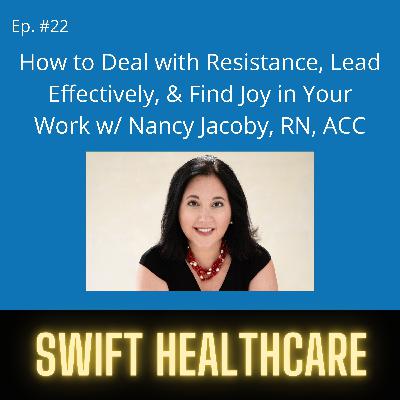
22. How to Deal with Resistance Lead Effectively & Find Joy in Your Work
Description
How do you Deal with Resistance, Lead Effectively, & Find Joy in Your Work? Nancy Jacoby RN, MBA, MHSA, FACHE, ACC guests on Swift Healthcare Podcast where we discuss all this and more! Tune in because you do not want to miss it!
Ranked a Top 60 Healthcare Leadership podcast by Feedspot.
Nancy Jacoby on LinkedIn:
https://www.linkedin.com/in/njacobyfache/
Music Credit: Jason Shaw from Audionautix.com
THE IMPERFECT SHOW NOTES
To help make this podcast more accessible to those who are hearing impaired or those who like to read rather than listen to podcasts, we’d love to offer polished show notes. However, Swift Healthcare is in its first year.
What we can offer currently are these imperfect show notes. The transcription is far from perfect. But hopefully it’s close enough - even with the errors - to give those who aren’t able or inclined to audio interviews a way to participate. Please enjoy!
Transcript
[00:00:00 ] Patrick Swift, PhD, MBA, FACHE: [00:00:00 ] Welcome folks to another episode of the Swift healthcare video podcast. I'm Patrick Swift, your host, I'm so excited about Nancy Jacoby being on the show. Nancy, welcome to the show.
[00:00:08 ] Nancy Jacoby RN, MBA, MHSA, FACHE, ACC: [00:00:08 ] Thank you, Patrick. It's a pleasure to be here with you today.
[00:00:11 ]Patrick Swift, PhD, MBA, FACHE: [00:00:11 ] It's a joy and the title of our show here is how to deal with resistance lead effectively and find joy in your work. I love that. And so folks, let me share with you Nancy's bio here, which I love doing the top of the show. Nancy Jacoby is a former healthcare executive with 25 years of experience in the industry. She's a board certified. She is board certified in healthcare management by the American college of healthcare executives and is a fellow of the college go ACHE. I'm a FACHE as well. So I'm delighted that you're on the show prior to serving in leadership positions, Nancy, as a registered nurse with a passion for caring for the geriatric patients, she's actually still licensed in two States and she founded Nancy Jacoby [00:01:00 ] consulting and Nancy Jacoby coaching and consulting. And I have to call out that you went to Xavier university in Cincinnati. Having a great love for the Jesuits. I got, I got to give a shout out for your you're a Jesuit education and being a Xavier.
[00:01:13 ] Nancy Jacoby RN, MBA, MHSA, FACHE, ACC: [00:01:13 ] That's right. I'm proud to be a Xavier alum.
[00:01:16 ] Patrick Swift, PhD, MBA, FACHE: [00:01:16 ] Outstanding. So we're going to talk about how to deal with resistance lead effectively and find joy at work. And if I may, let me also ask you, we did a little prep folks on before the show and about, you know, the arc of the book. Podcasts we're taping here, but I want to also ask you what got you into health care. If I may what drew you into healthcare and the passion you have because it's so strong and the impact you're having you know, what's your, what's your, why? What drew you into healthcare?
[00:01:44 ] Nancy Jacoby RN, MBA, MHSA, FACHE, ACC: [00:01:44 ] Well, you know, Patrick, it's funny because you know, you fill out these child books that your parents give you, you know, year by year with, you know, your grade school teacher and your friends. And what do you want to be when you grow up and early on, I identified looking back, I identified a lot of focus [00:02:00 ] on. What I would call helping professions, you know, being a nurse, being a teacher and nurse stayed there for a good couple of years. Right. And you know, when I, when I first went to college at Xavier I started out as a psych major because I always had a gravitation towards people with, you know, emotional health needs. And I just, I got attracted to nursing because I felt like I could serve the whole patient and the whole person. And the mission of caring for the sick. I mean, what, what's more noble than that, right? I've always been attracted to something where in some way, shape or form, I'm going to have an impact. That's more than just on paper. Like I wanted to have a tangible impact
[00:02:44 ] Patrick Swift, PhD, MBA, FACHE: [00:02:44 ] Yeah. Yeah.
[00:02:45 ] Nancy Jacoby RN, MBA, MHSA, FACHE, ACC: [00:02:45 ] and that that's, that's really what drew me to nursing. And. It drew me into healthcare administration, believe it or not, because I could make an impact on so many different levels. You know, people might say, well, that sounds [00:03:00 ] strange. How do you do that? Well, because you can, you can touch the patient. You can touch the organization. And then in a leadership role, you have the awesome responsibility to lead mentor and develop others. And it was probably one of the most fulfilling parts of my job.
[00:03:17 ] Patrick Swift, PhD, MBA, FACHE: [00:03:17 ] Aw. Oh, I mean, it's really, I love that because it's, it's pulling together all of the intention you had of being in the helping profession, even as a young person. And then, and then being in the workforce and being a healer and coaching and helping others heal and. You know, I hope listeners are thinking about what got you into health care yourself, or if you're thinking about healthcare the show is for, from the CEO to the new employee, to the aspiring healthcare professional we all can learn, we can all find inspiration and joy from each other.
[00:03:45 ] And thinking about what drew you into healthcare, Nancy I think is beautiful for our listeners also to think about what drew you into healthcare. Cause hell if we can connect more and more to a purpose, it is a protective. Barrier protective factor from [00:04:00 ] burnout. Because if we're dealing with burnout, one of the biggest things we can do is connect to our meaning and purpose. And so I love you sharing that short story as a neuropsychologist. I know listeners can't help, but be thinking about that question for themselves. Well, why am I doing this? And it gets back to purpose. So. One of the challenges in dealing with burnout, whether you're a provider, whether you're a physician, a nurse, a clinician, or a leader, or both is we all deal with resistance. And so I'd love to, I love this. You've got amazing blog. You've got a lot of great content out there. Let's talk about, here's the question? What do you mean by making friends with resistance?
[00:04:38 ] Nancy Jacoby RN, MBA, MHSA, FACHE, ACC: [00:04:38 ] Absolutely. And people who are listening right now, they, they must be thinking, you're crazy. How can you make friends with resistance? Right. It's, you know, it's funny because when people think of resistance, a lot of the times it's, it's something negative, you know? So if I'm doing a workshop or if I'm having a conversation like this, when I, when I ask people, well, what's the first thing that comes to mind. When you think of resistance, it's [00:05:00 ] often negative words like, you know, right. I hear words like obstacle, blockade, stubborn impeding progress, you know challenge, you know, conflict. Right. And it doesn't have to be that way because resistance is really a natural part of any change that we're bringing to the table. Whether it's
[00:05:22 ] Patrick Swift, PhD, MBA, FACHE: [00:05:22 ] And you said the change work. Cause then people, then we can't help, but think of like, Oh, blood pressure. Right. And what you're doing is normalizing that normal part of what we do, right?
[00:05:33 ] Nancy Jacoby RN, MBA, MHSA, FACHE, ACC: [00:05:33 ] absolute normal part of what we do, whether whether we're undergoing an individual change that we think might be very simple, or whether we're helping a team go through a change or, you know, Patrick at the organizational level, if we're doing something huge, you know, like a merger and we're going to bring two organizations together, like. The potential for resistance there on so many levels is very high because it's normal. It's, [00:06:00 ] it's, it's, it's like a friend that you have next to you all the time. Just welcoming it to the table and saying, I know you're here. Glad you're here with us. Let's figure out how to use you.
[00:06:11 ] Patrick Swift, PhD, MBA, FACHE: [00:06:11 ] I love that angle about how to then use resistance, because I love to contemplate the notion of the yoga of healthcare being a meditator and, and the notion of. Yoga of healthcare, this notion of developing our flexibility and our, our, our, our, our skills and our abilities and using resistance as part of the physical yoga. But here, you're talking about using resistance to be more. More, whether it's effective, be more healthy, to be more happy to be more effective as a leader, this, this you know, you've written it can be a gift. So what are your thoughts about, you know, how, how is resistance a gift?
[00:06:53 ] Nancy Jacoby RN, MBA, MHSA, FACHE, ACC: [00:06:53 ] Absolutely. Well, you know, if you think about why re why we resist, right. [00:07:00 ] Oftentimes on some level, there's some sort of fear factor in there, whether it's, you know, at the individual level we're undergoing some sort of change or we're trying something new, right. We may be kind of afraid of it. Going back to that big organizational context, like, you know, Holy smokes, we're bringing two organizations together. And. This is huge, right? It's huge on so many levels. We're bringing together cultures and finances and teams and information systems, all these things that are coming together when the resistance is coming to the table. And you know, it's funny. Cause I, I read a great book about resistance, a guy named Rick Mauer wrote beyond the wall of resistance and he talks about three levels of resistance.
[00:07:43 ] And when I think about some of the projects that I've led in healthcare, it's, it's just so on the money because when resistance shows




 United States
