


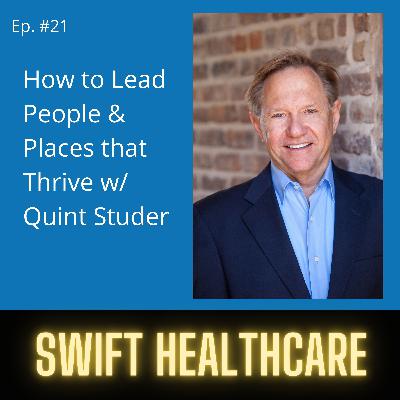
21. How to Lead People & Places that Thrive w/ Quint Studer
Description
How do you lead people & places that thrive? Quint Studer guests on Swift Healthcare Podcast where we discuss his Wall Street Journal bestseller “The Busy Leaders Handbook,” the importance of addressing our own emotional health as well as the emotional health of our workforce, and critical concepts that all leaders and aspiring leaders can benefit from hearing. Plus what’s next on the horizon from Quint’s upcoming book titled, “The Calling.” It’s a MasterClass from a legend in healthcare and you do not want to miss it!
Ranked a Top 60 Healthcare Leadership podcast by Feedspot.
Listen & Watch: https://swifthealthcare.com/podcast/
Apple Podcasts: http://apple.co/3aFpEpl
YouTube: https://youtu.be/g5QLzwVc9CM
(A Top Healthcare Leadership YouTube Channel)
Quint Studer Links for Show notes:
https://thebusyleadershandbook.com/
https://gratitude-symposium.heysummit.com/
Music Credit: Jason Shaw from www.Audionautix.com
THE IMPERFECT SHOW NOTES
To help make this podcast more accessible to those who are hearing impaired or those who like to read rather than listen to podcasts, we’d love to offer polished show notes. However, Swift Healthcare is in its first year.
What we can offer currently are these imperfect show notes. The transcription is far from perfect. But hopefully it’s close enough – even with the errors – to give those who aren’t able or inclined to audio interviews a way to participate. Please enjoy!
Transcript
MasterClass: How to Lead People & Places that Thrive w/ Quint Studer
[00:00:00 ] Patrick Swift, PhD, MBA, FACHE: [00:00:00 ] Welcome folks to another episode of the Swift healthcare video podcast. I am so excited about our guest for this show. Today, we have Quint Studer, Quint. Welcome to the show.
[00:00:10 ] Quint Studer, MS: [00:00:10 ] I'm pumped about you being here, in fact, and I own a minor league baseball team and it's all about high energy, high fun. And if you're not, if you're thinking about getting a side job on healthcare, we could use you at the ballpark now. So thank you.
[00:00:24 ] Patrick Swift, PhD, MBA, FACHE: [00:00:24 ] I would, I would jump at that chance, , you know, be careful what you ask for Quint. I'm a,
[00:00:28 ]Quint Studer, MS: [00:00:28 ] We're ready.
[00:00:29 ] Patrick Swift, PhD, MBA, FACHE: [00:00:29 ] My wife's in Miami right now, visiting some family. I think I'd be happy to get down on the Pensacola. Folks, if you can feel the love. , I hope you can because the man we have on the show here, , I, , have the greatest respect for, and you are in in for a treat and, , Quint. I know you're a humble man. , and I just want to acknowledge how, , you have impacted this profession. So folks, if you are listening, pay attention because I have a master class for you in this conversation.
[00:00:56 ] And most importantly, with my values, it's about joy, [00:01:00 ] hope, compassion, courage. And who better to have on the show than Quint Studer. So here's Quint's bio. If you don't know who Quint Studer is, listen to this Quint Studer is a well-known healthcare operator, author, coach, and mentor to many, many, many, many.
[00:01:15 ] He has dedicated the last three decades to creating tools and techniques that make healthcare a better place for physicians to practice medicine, patients, to receive care and employees to work. He's written numerous books. I've got a couple here on my desk. I'm going to show you articles. And his work is always based on evidence, research and tools and techniques. So Quint Studer, welcome to the Swift healthcare video podcast.
[00:01:40 ] Quint Studer, MS: [00:01:40 ] No, no, I'm excited to be here. Thanks for the opportunity.
[00:01:43 ] Patrick Swift, PhD, MBA, FACHE: [00:01:43 ] Absolutely Quint. So let's kick it off with some fun here. And, , uh, I want to ask you in your own words what got you into healthcare? Why do you do what you do? Quint?
[00:01:54 ] Quint Studer, MS: [00:01:54 ] Well, it's going to be way different than most people think. , alcoholism got me into healthcare. [00:02:00 ] Um, I was, When I was 31 years old, December 24th of 1982, I crashed, I surrendered personally. All of a sudden I had that moment of clarity. They talk about, and I said, this isn't my life's not trending in the right direction.
[00:02:16 ] And so I sought help and I'm a recovering alcoholic. I'm in my 39th year of sobriety. So how I got into healthcare was I was, it's going to 12 step meetings at a hospital that treated people for alcoholism. And I was going to meetings and, , I saw an ad that they were looking for someone to work at the treatment center in, in working with school districts and employers. And because I was a teacher of children with special needs. and when, once I got in recovery, I started something called a student assistance program. It mirrored an employee assistance program, but for students that they could reach out, particularly if they had a family member or so on. So i.
[00:02:55 ] Patrick Swift, PhD, MBA, FACHE: [00:02:55 ] you did Quint. That's great. That's fantastic!
[00:02:59 ] Quint Studer, MS: [00:02:59 ] I, I, [00:03:00 ] um, talked to them and they hired me as a community relations rep. And I did that for three years and one employee, a worked in a hospital before they went back to work, we did something called a back to work. And I, , went with them to talk to the human resource person about how do they reenter the workplace. And one day a human resource person at a hospital in Wisconsin said, you know, we have an opening here. In marketing community relations, you really do a good job. Why don't you come here? So that's how I got into healthcare. So when I speak to colleges, they want to know my career track. I say, well, it might not be the one you want to follow, but it is what it is.
[00:03:38 ] Patrick Swift, PhD, MBA, FACHE: [00:03:38 ] Uh, I, I love that Quint because I love the expression. , Turning your, your kryptonite into super your super power. And, , what you've done in the arc of this story even is acknowledging, , the, the sorrow and the rock bottom and the insight and the compassion that arose from that. And by [00:04:00 ] that suffering and sorrow has led to, a global impact on raising the bar in healthcare,
[00:04:06 ] Quint Studer, MS: [00:04:06 ] Yeah, we
[00:04:07 ] Patrick Swift, PhD, MBA, FACHE: [00:04:07 ] in
[00:04:07 ] Quint Studer, MS: [00:04:07 ] You know in recovery when you help, when you help somebody recover, they call it 12 stepping or bringing 12 steps to them. And I tell people I've been 12 stepping healthcare now for a while.
[00:04:17 ] Patrick Swift, PhD, MBA, FACHE: [00:04:17 ] I love it. I love it. So folks, , step on up let's step here. , I I'm, I'm inspired by that. , , , Phrase, turn of phrase. We're we're, we're 12 stepping healthcare here. , there's so much for us to talk about in thinking about this conversation. One of the first questions I want to ask you, , is listen, folks I've got Quint has published many books. I've got. , the busy leaders handbook, how to lead people in places to thrive, building a vibrant community. , but the first one I read of Quint's , this is my favorite. , you can see it's dog ear-ed and got all kinds of notes on it ears, hardwiring excellence. And, , I happen to love this book and I wanted to ask the author. , what, , what about that book, , is your favorite [00:05:00 ] part, your favorite message that stands out of that book?
[00:05:02 ] Quint Studer, MS: [00:05:02 ] Well, I think that my favorite part is when you read the stories about people recapturing their purpose in healthcare. For example, on page 251, I got, I got a letter from a person who I'm and I'll just read it real quick and I'll, I won't read the whole, whole thing. It says, ,
[00:05:18 ] I know I make a difference. One of my employees who had been here just about a year, became employee of the month when it was announced, she received the recognition of brought tears to her eyes. She was pleased during the whole month. Usually she was very quiet and somewhat withdrawn. During this month. She was one of the girls. We talked about things with their coworkers that she had never talked about before.
[00:05:37 ] The moment I realized just how much it meant to her was when she was diagnosed with cancer is during the month she was employee of the month while talking to her husband about a return to work. He mentioned to me that she never felt so included and proud in her whole life. The job here at the hospital is a dream job for her, and she had really not felt worthy of working here.
[00:05:55 ] Just so proud of her employee, of the month plaque , that she hung in her living room for all to see during your [00:06:00 ] illness. She felt she had an extended family. She said she felt loved by her coworkers. We visited her on a regular basis and called her several times a week to see if she needed anything about five months later, Susan, our coworker died. We were very sad at her passing. I personally attended her funeral with four other women from our office. As we approached the coffin, we saw something at the exact same moment that we could not believe on the back of her coffin. next to her shoulder was her employee of the month plaque and a card signed by all of us in the office at that moment in m





 United States
