


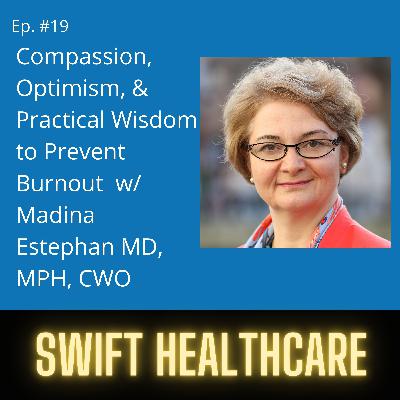
19. Compassion, Optimism, & Practical Wisdom To Prevent Burnout w/ Madina Estephan, MD, MPH, CWO
Description
This episode records from Paris, France where we discuss the impact of COVID, keys to resilience for healthcare professionals, and practical wisdom to prevent burnout.
Ranked a Top 60 Healthcare Leadership podcast by Feedspot.
Dr. Estephan on LinkedIn:
https://www.linkedin.com/in/madinaestephanhealthcarecwo/
Music Credit:
Jason Shaw www.Audionautix.com
THE IMPERFECT SHOW NOTES
To help make this podcast more accessible to those who are hearing impaired or those who like to read rather than listen to podcasts, we’d love to offer polished show notes. However, Swift Healthcare is in its first year.
What we can offer currently are these imperfect show notes. The transcription is far from perfect. But hopefully it’s close enough - even with the errors - to give those who aren’t able or inclined to audio interviews a way to participate. Please enjoy!
Transcript
[00:00:00 ] Patrick Swift, PhD, MBA, FACHE: [00:00:00 ] Welcome folks to another episode of the Swift healthcare podcast . I'm Patrick Swift, your host, and I want to thank you for being here. Thank you for listening from South Africa and Latin America and Europe and the United States and all over. I'm grateful for our listeners and thank you for your support, uh, for the podcast as well. So for our show today, I have a wonderful guest, Dr. Madina Estephan, Madina . Welcome to the show.
[00:00:24 ] Madina Estephan, MD, MPH: [00:00:24 ] Hello. Hello, Dr. Swift . Thank you very much for inviting me. I'm so glad to be here today on show.
[00:00:34 ] Patrick Swift, PhD, MBA, FACHE: [00:00:34 ] I'm delighted you're here. I know that I know you used the word to let it all the time because I am delighted. Uh, and I'm so delighted to hear folks. Um, Dr. Estephan Madina , uh, is in Paris, France. And so I'm just like jump up and down. Pinch myself, excited, having been to Paris, having a great love for Paris as in American, how wonderful it is to have a guest on the show that's broadcasting from Paris, so, and a physician from Paris. So. [00:01:00 ] Here's Dr. Madina Estephan's bio coming from a family of three generations of healthcare professionals. Dr. Estefan, whose passion for the medical field was inspired at an early age. Can you imagined growing up at that household? , it led her to earn a medical degree. Obtain a master's degree in public health and as a multilingual multicultural health professional with over 20 years, clinical practice and international management experience, her career has been focused on training and consultancy. And she's focused on empowering you.
[00:01:31 ] She's focused on empowering healthcare professionals, healthcare leaders, healthcare providers, um, to unfold their therapeutic excellence. Unlock internal resources and unleash practical wisdom. I love that. I think we could all, you know, I got some gray hairs and lost all the hair on the top of my head. I think we could all use some, um, some wisdom and practical tools.
[00:01:51 ] So we're focusing on compassion, optimism, and practical wisdom for this episode. So that being said, Dr. [00:02:00 ] Estefan, let's just jump in Medina or a question here. Um, you know, welcome to the show from Paris. What's going on in Paris, right in here. What's the what's what's the latest. How, how, how are things.
[00:02:12 ]Madina Estephan, MD, MPH: [00:02:12 ] Listen, the good news. I have two news. Good news. Bad news. I'll start with the good one. The good news is that we have wonderful weather and the spring came. And so, uh, that's, uh, gives your energy, right? And the other staff is that we were in the middle of the pandemic. That's a bad piece of news, but we're rather struggling and the making all the best in the healthcare systems, this, , third wave slowly but surely so, and hopefully we'll be over that. And then we will welcome guests from the other side of a planet in Paris. One day.
[00:03:00 ] [00:03:00 ] Patrick Swift, PhD, MBA, FACHE: [00:03:00 ] Of course, of course I was listening to BBC and, uh, yesterday world service. And, um, there was a piece on, I believe, 80,000 new cases and, , you as a leader in, um, services and consulting and support, um, I know that you're in the middle of, , , helping healthcare professionals, , dealing with the burnout and the struggle and the pandemic and, and for the show, we're focusing on compassion, practical wisdom, and optimism.
[00:03:30 ] One of the things you talk about as soft skills and the importance of soft skills, and I would call them survival skills as well. What are the, what are the soft skills that, that healthcare professionals can be mindful of in their daily life right now? Just to get through everything going on.
[00:03:49 ] Madina Estephan, MD, MPH: [00:03:49 ] So you're absolutely right. It's not only survival skills. So I will say like French people also, so savoir vivre , right. Uh, [00:04:00 ] to know how to leave, you have to know to know how to be in Samoa fair, to know what to do. So let's call them survival or even human skills or skills of how to be, right. So, because somewhere what to do, we know as healthcare professionals and patient is expecting from us, the knowledge they expertize.
[00:04:32 ] So knowledge in your specific specialty, the hard knowledge, right? And the other side, we need those survival skills, uh, to know how to be ourself, how to protect ourselves, how to give the best of ourselves. Right. So, and amongst those soft skills for me, there are some which is absolutely [00:05:00 ] necessary to have in your toolbox, like a tool of books, like compassion, optimism, or those ma uh, practical wisdom skills, which are in a capacity.
[00:05:14 ] I think of the health care professionals. So, and when talking about compassion, Coming from the Latin word com passion , literally, which means I suffer with is the capacity of feeling suffering of the other's pain. Right. But all the other sides there is another part of the story is the willingness to act and do something to relieve suffering from the other one .
[00:05:45 ] Right. This is the, the, uh, the most, let's say demanding part of the compassion to be compassionate. I like the composition that compassion is in love in [00:06:00 ] action. It means to be able to put. Some kind of action plan to relieve the suffering from others. But as healthcare professionals, we're deeply suffering ourselves.
[00:06:14 ] Right? When we exercising our duty everyday duty activities, we have plenty of professional risks. There, including emotional exhaustion, distress, burnout, et cetera, and, uh, compassion, fatigue. So, first of all, we have to learn how to be compassionate with ourself, right. To stop and use the skills of compassion toward ourselves as the healthcare professionals and be able to them.
[00:06:48 ] Patrick Swift, PhD, MBA, FACHE: [00:06:48 ] I'm so glad you said that because it's about. If, if we are reminded every day to be compassionate with our selves with ourselves, it's still not enough. [00:07:00 ] We in the health care profession, you saying the importance of self compassion and for a listener right now, whether you're a healthcare leader, healthcare provider, um, healthcare professional, anyone working in healthcare, uh, Dr. Estephan's . Voice I'm telling you the importance of self-compassion. We needed that every day, uh, to be compassionate with ourselves and, and Medina, you speak about, um, emotional assertiveness of, of, um, come across some things you've written. And, um, I would appreciate your thoughts about emotional assertiveness in light of preventing burnout or addressing burnout or reducing burnout.
[00:07:38 ] What's the importance of emotional assertiveness? What's that about?
[00:07:43 ] Madina Estephan, MD, MPH: [00:07:43 ] Thank you Patrick, for this question because emotional assertiveness actually is a tool. Let's say, well, it's not invented by me. It was invented by invented or concept alive by John Parr, who is a UK, uh, doctor of [00:08:00 ] psychology. And actually it's a kind of tool which helps you regulate difficult emotions.
[00:08:09 ]Okay. In the way of understanding that we all are looking for the inner state of happiness, right? And this inner state of happiness can be of different degree for, from calm to joy. Right. And to get the Zener state of happiness we're always handling or, um, uh, facing different type of emotions. I, those emotions, the principal one is an anger.
[00:08:42 ] When something's going on around ourselves, in the environment, something goes wrong. We react in the first reaction is always anger. Then there can be anger, which is not expressed. Right. And then w [00:09:00 ] we can not handle the singer or express it authentic when it's happened. We're going to. focus and anger deeply inside of ourself and hurting somewhere else, self knowing what's going on with you, internalized anger, which is actually the part of the story.
[00:09:23 ]So facing these anger and be able to express anger in the right manner and the right place with the right person is the kind of emotional assertiveness . Yes.
[00:09:38 ] Patrick Swift, PhD, MBA, FACHE: [00:09:38 ] I love it. I love it. The notion of being angry at the right person at the right reason at the right time,
[00:09:45 ] Madina Estephan, MD, MPH: [00:09:45 ] authentically yes, typically affected that's that's the most important and how to learn, how to, to learn, to express the singer. First of all, to feel it, to [00:10:00 ] understand why, where. And from which part of you is coming from the past experience over the future experience, and th




 United States
