


301-apCAF Spatial Niches Define SPP1-Driven Tumor Virulence
Update: 2025-12-07
Description
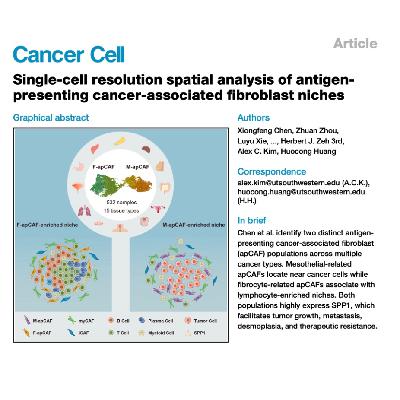
This article utilizes single-cell resolution spatial analysis across multiple solid tumors to characterize antigen-presenting cancer-associated fibroblasts (apCAFs). The study reveals two distinct apCAF populations—M-apCAFs (mesothelial-related) and F-apCAFs (fibrocyte-related)—that exhibit different spatial localizations within the tumor microenvironment. Specifically, the F-apCAFs are found predominantly in lymphocyte-enriched niches, while the M-apCAFs associate closely with cancer cells. A major functional finding is that both apCAF populations are the primary stromal source for secreted phosphoprotein 1 (SPP1), a protein known to drive tumor progression and therapy resistance. Further functional experiments in mouse models of peritoneal metastasis and pancreatic cancer demonstrate that targeting or knocking out host SPP1 significantly inhibits tumor growth and metastasis. The authors conclude that these spatial and molecular distinctions provide an important framework for understanding CAF heterogeneity and suggest that anti-SPP1 therapy may overcome therapeutic resistance.
References:
- Chen X, Zhou Z, Xie L, et al. Single-cell resolution spatial analysis of antigen-presenting cancer-associated fibroblast niches[J]. Cancer Cell, 2025.

Comments
In Channel






Download from Google Play

Download from App Store
 United States
00:00
00:00
x

