


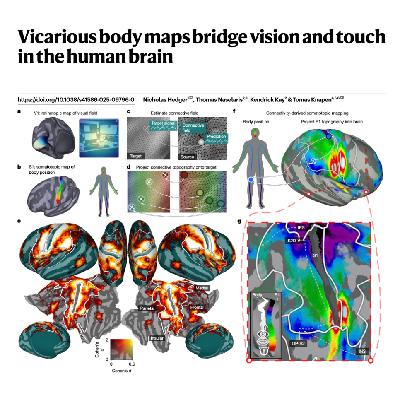
305-Topographic Body Maps Tiling Human Visual Cortex
Update: 2025-12-09
Description
This paper introduces a computational model to investigate how the brain bridges visual input and the sense of touch, or somatosensation, focusing on the mechanism behind vicarious sensory experiences. Utilizing this model on fMRI data, the authors first confirmed the existence of intrinsic, organized somatotopic maps representing body-part tuning across the known somatosensory network during rest. A major finding was that this somatotopic organization expanded profoundly into the dorsolateral visual cortex during video viewing, demonstrating that visual input alone recruits spatially structured representations of touch. These newfound somatotopic maps in visual areas were shown to align with both visual field positions and categorical preferences for visual body parts. This revealed a pervasive cross-modal interface in brain organization that is ideally suited to translate visual impressions into body-referenced formats necessary for action and social understanding.
References:
- Hedger N, Naselaris T, Kay K, et al. Vicarious body maps bridge vision and touch in the human brain[J]. Nature, 2025.

Comments
In Channel










Download from Google Play

Download from App Store
 United States
00:00
00:00
x

