


308-Neural Coding of Universal Phonetics and Word Structure
Update: 2025-12-10
Description
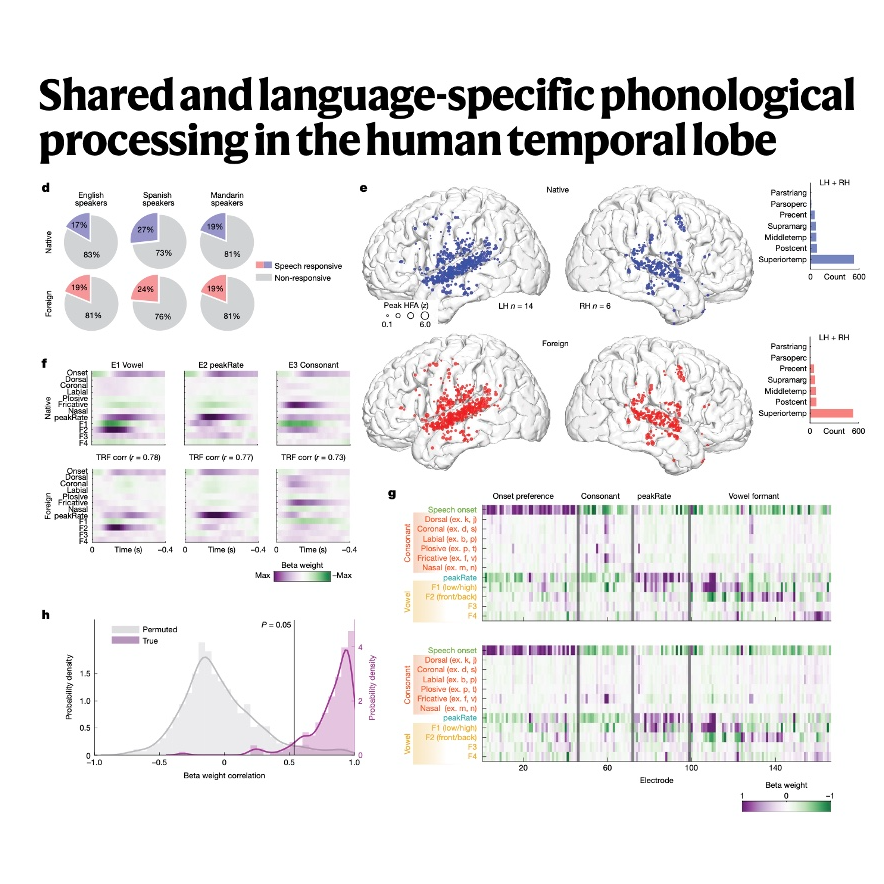
This research investigates the neural mechanisms in the human temporal lobe that differentiate between processing familiar and unfamiliar spoken languages, using high-density brain recordings (ECoG) in monolingual and bilingual speakers. The study determined that the superior temporal gyrus (STG) exhibits similar cortical activation and feature encoding for basic acoustic–phonetic features, such as vowels and consonants, regardless of whether the language is known or foreign. Critically, only when listening to their native language did the participants show enhanced neural encoding for higher-level linguistic structures, including word boundaries, word frequency, and specific sound sequence statistics. This strong dependency on experience indicates that the ability to segment continuous speech into individual words is a learned, language-specific skill localized to the STG. For bilingual individuals, this word-level processing capacity was available for both familiar languages, and the neural accuracy of extracting word-level information directly correlated with the speakers' proficiency in that language. These results propose a neurobiological model wherein the STG functions as an interface that integrates shared auditory processing with dynamic, experience-dependent word knowledge.
References:
- Bhaya-Grossman I, Leonard M K, Zhang Y, et al. Shared and language-specific phonological processing in the human temporal lobe[J]. Nature, 2025: 1-12.

Comments
In Channel








Download from Google Play

Download from App Store
 United States
00:00
00:00
x

