


How Much Are Texans' Power Bills Going Up? with TEPRI's Margo Weisz
Description
Everyone’s talking about the cost of power lately. But the Texas Energy Poverty Research Institute has been studying, talking, writing, and working to do something about it, for over a decade.
In recent research, TEPRI found that 65 percent of low and moderate income Texans are cutting back on essential energy use, often turning off AC in extreme heat. But their demand reductions aren’t necessarily saving them much money or supporting the grid.
Affordability is now a very high salience issue and there’s no one better to help us understand than TEPRI Executive Director, Margo Weisz. She talked about energy burden and affordability in Texas and the clearest paths to ratepayer relief.
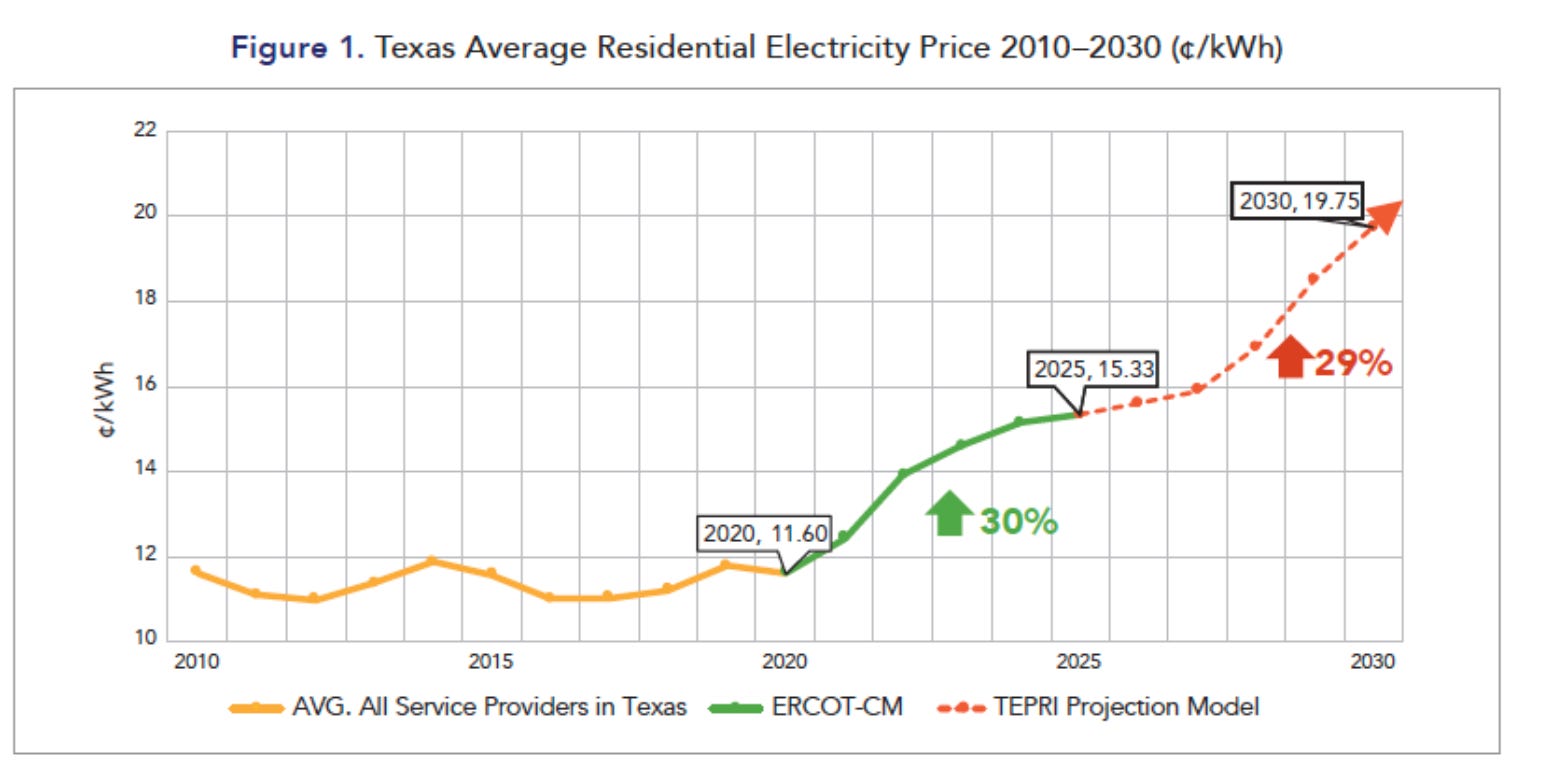
TEPRI’s latest research shows bills increasing sharply over the last five years and again in the next five years: TEPRI Releases ERCOT Electricity Affordability Outlook: Forecasting Residential Electricity Prices and Burdens (2025-2030)
Energy burden is rising sharply
Energy burden is the share of income spent on electricity. In Texas:
* ~4.5 million households are low or moderate income.
* Their average electricity burden for a low income Texan is nearing 7% — that is, they pay 7% of their income for their power costs alone — and expected to be 9% by 2030.
* TEPRI’s modeling shows about a 29 percent increase in the cost of power over the last five years, with another 29 percent projected for the next 5 years.
* The biggest increases are coming from transmission and distribution utilities.
Wages are not keeping pace, leaving an average affordability gap of roughly $850 per year.
Because of this, households are taking risky steps — or getting shut off
As TEPRI’s survey shows, they are turning off or limiting AC in dangerous heat, skipping essentials to pay the bill, and accumulating arrears until shutoff notices arrive. And 12% were actually shut off. But Texas does not track disconnects so we don’t know if this survey matches actual shut-offs.
These actions point to system-level strain. They increase health risks and make reconnection more expensive for everyone.
Efficiency and distributed energy are long term solutions
Efficiency is the fastest, cheapest way to cut bills and peak demand. Weatherization and efficient HVAC could reduce load and permanently lower costs for the households who feel the most pain.
Distributed energy goes one step further. Community solar, batteries, and virtual power plants at homes and apartments can lower bills, reduce peak load and improve resilience.
Final Thoughts
Energy burden is the lived reality of the Texas grid. Millions of Texans are paying nearly 9 percent of their income for electricity, and many are already taking unsafe steps to stay connected.
But we have real options. Smarter enrollment for bill help. Scalable efficiency. Community solar and virtual power plants that lower costs and support ERCOT.
If this work matters to you, share it with someone who cares about Texas energy, and consider subscribing so we can keep tracking what works and where Texas can lead.
Timestamps
* 00:00 – Intro and why energy burden matters
* 02:00 – Margo’s background and TEPRI’s mission
* 04:00 – “energy limiting behaviors” often aren’t saving much money
* 05:00 – Community Voices Energy Survey and behaviors
* 06:30 – How Bandera Electric Co-op is helping their customers
* 08:30 – Texas does not track disconnect data
* 10:00 – “Sexy energy efficiency” and heat pumps; the split incentive problem
* 12:00 – TEPRI’s approach to applied research
* 13:30 – Defining and measuring energy burden
* 17:00 – the potential for energy abundance and what that means for low-income Texans
* 19:00 – Texas rates are lower but rising faster than the national average. Why?
* 22:00 – How do we allocate costs for socialized grid upgrades and storm recovery? (SB 6 implementation)
* 27:00 – What’s going to happen to bills in the next 5 years?
* 30:00 – Where some downward pressure for prices could come from
* 32:00 – What do we do about all this?
* 35:00 – Bill assistance and the future of LIHEAP
* 36:00 – Scaling efficiency and demand response in Texas
* 39:00 – Virtual power plants in low-income communities
* 41:00 – Enlightened self interest: helping those in need helps everyone
* 43:00 – Margo’s closing thoughts
Resources
Guest & Company
* Margo Weisz – LinkedIn
* Texas Energy Poverty Research Institute (TEPRI) - LinkedIn
Company & Industry News
* TEPRI New Report: “ERCOT Electricity Forecast Outlook”
* TEPRI Receives Outstanding Non-Profit Award at Texas Energy Summit
* TEPRI 10-Year Anniversary Celebration and Future of Energy in Texas
* Community Voices Energy Survey
* Low Income Energy Assistance Program on TX System Benefits Charge
Related Podcasts by Doug
* Why Your Utility Bill Keeps Rising YouTube
* Creating a Distributed Battery Network with Zach Dell YouTube
* How Data Centers Can Strengthen the Texas Grid with Astrid Atkinson YouTube
Related Substack Posts by Doug
* The Affordability Crisis Deepens: Reading & Podcast Picks, August 31, 2025
* An Expensive and Unnecessary Capacity Market
* Texas Has Never Had a Summer Blackout — Here’s Why That May Change
Transcript
Doug Lewin (00:05 .548)
Welcome to the Energy Capital Podcast. I’m your host, Doug Lewin. And my guest this week is Margo Weisz. She is the executive director of the Texas Energy Poverty Research Institute or TEPRI.
Everybody these days is talking about affordability, and rightfully so. Affordability played a very important role in the recent elections in New Jersey, Virginia, and Georgia. And we are seeing increasing numbers of Americans and of Texans that are struggling to pay their bills, that are making that terrible choice between food, medicine, and their power bills. As high as 30 and sometimes 40% of Texans making those choices. TEPRI has done incredible work with their Community Energy Voices survey, where they surveyed 6,500 low-income Texans and found that more than 60% of them were engaged in energy-limiting behaviors. Translation of energy-limiting behaviors is, in some cases, particularly with medically vulnerable populations, extremely medically risky. This is a problem we’ve got to solve together. And as I talked about with Margo, who’s just a fantastic leader in this space in Texas, the solutions actually can help across the grid. One of the things TEPRI is working on is distributed energy resources at multifamily facilities. And one of the things we talked about there is how all of us benefit from implementing those kinds of solutions. It’s what I’ve referred to—I didn’t come up with this term; I’ve heard it in a lot of different places—but enlightened self-interest. If we are getting solar and storage and energy efficiency out widely, particularly to low-income Texans, that strengthens the grid for all of us while it lowers their energy bil







 United States
