


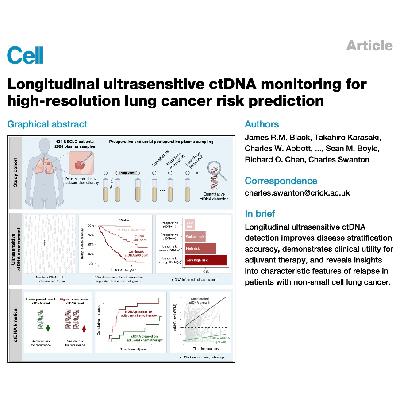
291-Prognostic ctDNA Monitoring in Resectable NSCLC
Update: 2025-12-04
Description
This article details a study focused on using longitudinal ultrasensitive circulating tumor DNA (ctDNA) monitoring to improve risk prediction and management for patients with non-small cell lung cancer (NSCLC). The research, based on the TRACERx study cohort, leverages a highly sensitive, tumor-informed ctDNA assay to detect molecular residual disease (MRD) both before and after surgery. Findings indicate that ctDNA detection levels, particularly those below 80 parts per million (ppm), are crucial for stratifying patient prognosis and identifying an intermediate-risk group. Furthermore, the kinetics of ctDNA clearance during adjuvant therapy are predictive of clinical outcome, suggesting a refined, ctDNA-guided approach for recommending and monitoring NSCLC treatments.
References:
- Black J R M, Karasaki T, Abbott C W, et al. Longitudinal ultrasensitive ctDNA monitoring for high-resolution lung cancer risk prediction[J]. Cell, 2025.

Comments
In Channel






Download from Google Play

Download from App Store
 United States
00:00
00:00
x

