


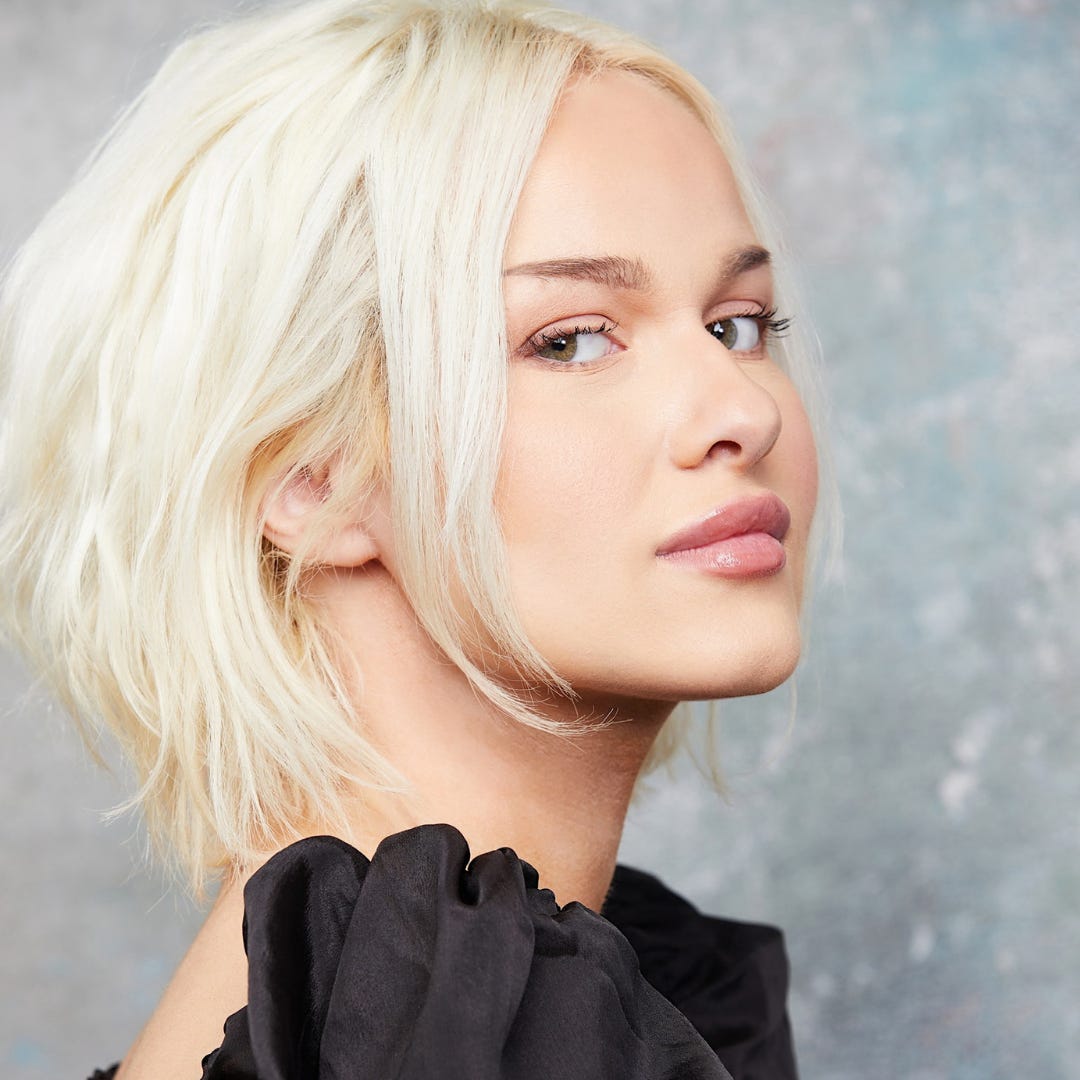
Continued Conversations with Scarlett Dyer
Description
Everyone please welcome my wonderful friend and fellow creative Scarlett Dyer to A Broadway Body: Continued Conversations! Scarlett and I met when we both first moved to Los Angeles in 2019 through the Crash Acting community, and we have been friends ever since. Scarlett is an actor, a fashion designer, a costume designer, a writer, and an activist. She designed the wardrobe for my short film, “A Broadway Body,” and she has recently written an original feature film screenplay featuring a female lead who’s in a wheelchair.
Scarlett is a bright, shiny, vibrant incredible force of a human being, not to mention extraordinarily talented, and I am so thrilled for you to hear our conversation. We discuss all things ableism in Hollywood, how Scarlett is working to normalize leading roles that feature disabled actors, and her experience of existing in a wheelchair as an actor. She is making such an impact in the many different creative areas she lives in, and I cannot wait to see where she is ten years from now.
“ When I'm out with my friends at a bar just, like, living my normal life and some old man comes up to me and is like, “I just think it's so great that you're out living your life. You are out in public at night having fun. Good for you,” or someone else is like, “Um, you don't look like you need a wheelchair. Why are you in a wheelchair?” Like, excuse me. Don't look —? What is that? What is that? Talk about body image. Like, what is that? What is that? Because I don't look classified disabled to you? That is so offensive, not only to me, but the entire community because it comes in all different shapes, sizes, forms, everything. ”
- Scarlett Dyer
Scarlett Dyer: Yes, I did just write a screenplay. It is a romcom, and it's called Get Lucky. It's set in Ireland. I went to Ireland about a year ago, and I was just so inspired, and I had so many just ideas coming to me driving around in a van and looking at cows and sheep and I was like, “This is so a romcom. This needs to be romcom.” And I was like, “I have to write this.”
Megan Gill: I love that.
Scarlett Dyer: I literally took things that actually happened and implemented it in a more dramatic way. So it's very close to home to me. And it features a female lead who uses a wheelchair because I'm a wheelchair user, and as an actor and a writer and a designer, that's really what I want to bring into the industry and to the world is a greater representation for this community because it has been so, so underrepresented. And we need a female lead in a romcom who is not tokenized, who is a real person, who is iconic and fun and badass, the whole nine. We need that. We need to see that. So yeah, I wrote it.
Megan Gill: You wrote it, Scarlett! You wrote the damn thing. And also she sounds a lot like the energy that you bring and the energy that you give.
Scarlett Dyer: Oh, I channeled myself. I sort of wrote what I know I guess.
Megan Gill: Right? Isn't that what all the advice tells us to do?
Scarlett Dyer: That's what they all say, just write what you know! And so, I was like, “Okay!” The character, she is different from me in a lot of ways. She's fictionalized. She has things that are a lot different from me, but we share the same disability. In that way we share similarities due to that. But she's different from me, yeah. I wanted to make sure of that.
Megan Gill: Oh, I'm just so glad that you are writing this role, and would the goal be for you to play her?
Scarlett Dyer: I definitely want to play the role, for sure, for sure, for sure. So this is kind of like the first thing I've written. This is my first feature film that I've written, original feature film. But I don't really know where to begin with producing, so I definitely think I might need some help with that area, just getting it to the right people and, you know, me making friends in that kind of way, but acting in it, yes, I'm so down for that. Yeah.
Megan Gill: Yeah. I love that, and I think that's really important and an important way to get your voice out into the world, not only as the writer but also as the person portraying the role as well.
Scarlett Dyer: Yeah, yeah. Yes, thank you for saying that.
Megan Gill: Of course. When I look at you and I look at the work that you're writing and the work that you do and how you show up in acting class and how you show up in the commercials that you're in, and I'm just frickin’ cheering you on because you're right, we do need more representation, and it's unfortunate that the cultural norm just chooses to leave disability out of the conversation a lot of times. They choose to leave a lot of things out, but it's like, this is something I feel like that we are starting to see a little bit more and more, but it’s not the norm. It’s not the go-to, right?
Scarlett Dyer: It’s really not. It's really not. Yeah, it's overlooked, and I am all about representation for all communities, for all marginalized groups. But yeah, you know, the disabled community has been so overlooked. And even going into auditions for these roles, like “wheelchair user,” they don't know what they're looking for. Are you looking for a manual wheelchair? Are you looking for a power wheelchair? It's different and sometimes they don't quite know what to expect, and that can also conflict with casting and it kind of can make it awkward sometimes. And it's like, “Well are you able to do this? Are you able to move your arms in this way and do this sort of thing?” And it's kind of like that sort of dehumanizes it in a way.
So I just really, with this script, it really shows how this character lives her life, and that is really what I wanted to show.
Megan Gill: I feel like that hits for me for you, being able to show up as you are and not have it questioned, not have someone ask you something.
Scarlett Dyer: I get asked so many things.
Megan Gill: I can only imagine. But also it’s so devastating and sad because that just falls down like the emotional labor of that –
Scarlett Dyer: Yeah.
Megan Gill: – constantly, I can imagine, is coming back to you and coming back to you. And yes, there's a lack of education in general in society, in our culture
Scarlett Dyer: Yeah, there is.
Megan Gill: But then showing up in a space, like in the casting office and having these questions asked of you, where we're already, you know, as actors, a lot of times you're showing up to an audition in person. The nerves are already there, and it's not fair for them to be tenfold because you're like, “Well, are they gonna ask me something out of pocket today? What weird question am I gonna have to answer today?”
Scarlett Dyer: And don't get me wrong, there have been so many, so many cool instances where they're so nice and so cool and like so accepting and excited to be casting differently-abled roles. But sometimes they'll just expect that I can do something, and then I show up to the thing and it's like I can't do it. And even some of the things my agent sends me – I had to have a meeting with them and just say, “This is kind of hard for me to do, these kinds of things.” Because doing self-tapes even when it's like, “Okay, well, they're obviously not gonna pick me because I can't do this activity,” you know?
Megan Gill: Mm-hmm.
Scarlett Dyer: Or I can do it, but I can do it in a different way – in my own way.
Megan Gill: You can do it in your own way, right.
Scarlett Dyer: Yeah, where it's like, I'm not sure they're gonna go for that. They're just gonna want somebody who can do it easily, quote “normally,” which I hate.
Megan Gill: Yeah, I hate that too. I'm sitting here thinking do you ever put yourself on tape for those roles where you're like, “They're probably not going to cast me because I quote unquote ‘can't do this’ the way they're probably gonna quote unquote ‘want to see it?’”
Scarlett Dyer: I still do.
Megan Gill: Okay, I love that. I love to hear that.
Scarlett Dyer: Yeah, I still do. Thank you. That’s so supportive!
Megan Gill: Even though I know mentally it potentially could be taxing I to have the preconceived notion that maybe you won't book it, but it's only because I've been there in my own ways as an actor.
Scarlett Dyer: Absolutely.
Megan Gill: And I don't mean to speak for you in that matter.
Scarlett Dyer: No, no, no. That is so accurate. And it's also like, okay, are they gonna see this and be like, “Hmm, nice try sweetie”? And that thought kind of makes me be like sometimes I don't want to do it. But then I over think that, and I'm like, “No, I'm getting in front of these people. It’s fine. I'm just gonna do it. I'm gonna do my best.” And yeah, I just recently did one for a makeup brand and they wanted – I do my makeup in a very unique way, and it's not typical, “Get ready with me.”
Megan Gill: You did a tutorial, and you shared it!
Scarlett Dyer: I did share it.
Megan Gill: And it was incredible, and I'm so glad you did that. It’s also so badass.
Scarlett Dyer: Thank you. That means everything. I love makeup. I've taught myself how to do makeup in




 United States
