


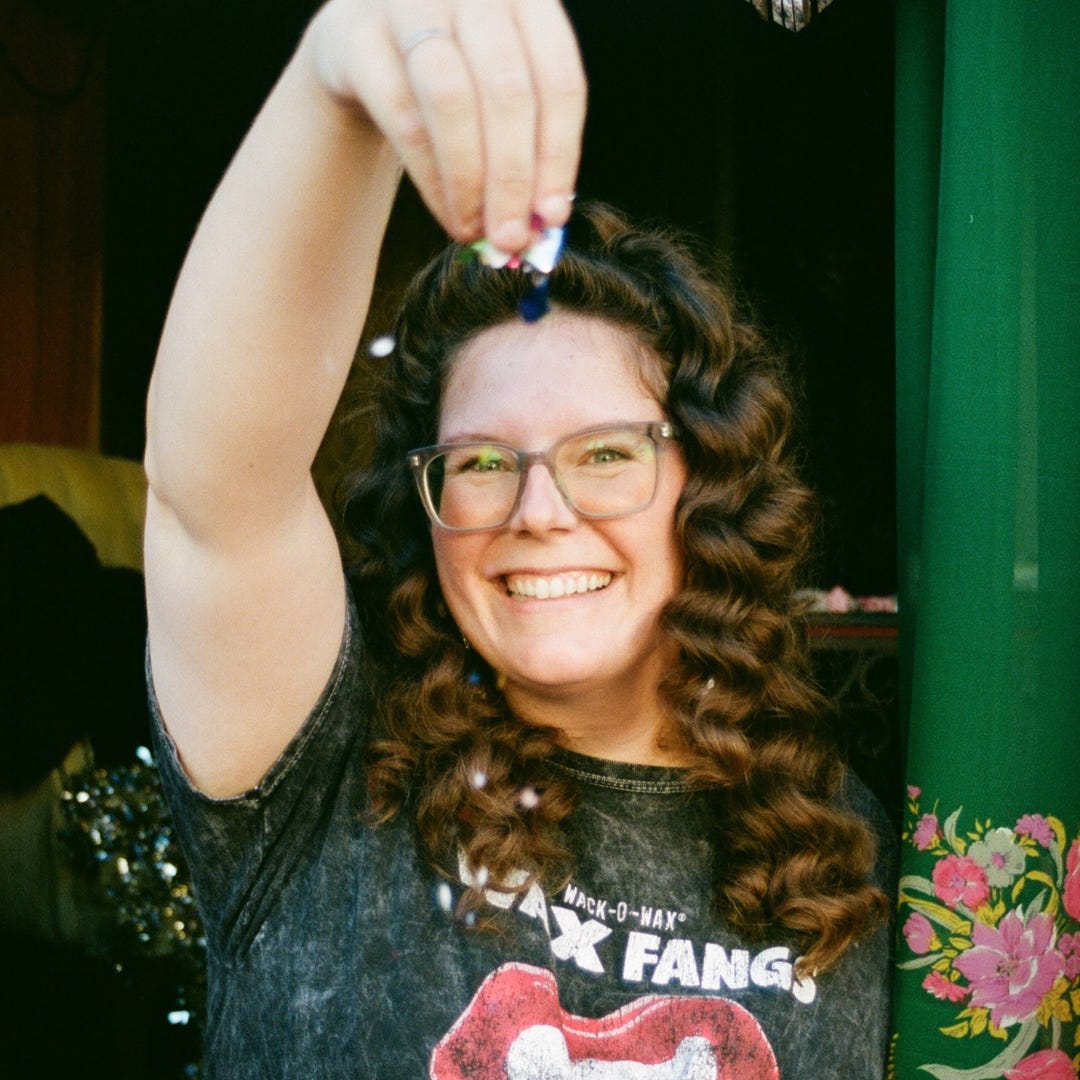
Continued Conversations with Stacy Keele
Description
Everyone please welcome my long-time friend and fellow musical theatre actor and entrepreneur, Stacy Keele, to A Broadway Body: Continued Conversations! Stacy is not only an actor, she’s also a certified Human Design reader + Neuro-linguistic Programming coach helping chronically-ill entrepreneurs build body-led businesses their way, so they can show up in business authentically and avoid burnout.
In our conversation, we discuss how the hustle and grind of pursuing a professional musical theatre career in NYC left Stacy sick and struggling, but also ultimately brought her to her work today. Stacy dives into how Human Design can bring us back into our bodies and help us better relate to the ways we are meant to move in the world. She also ties all of this into how she functions herself (and helps spoonie-preneurs function) best as women in business in chronically-ill bodies. Stacy is a true light, and I cannot wait for you to hear our conversation!
“If you're a chronically-ill actor, or you're on the verge, or you feel like you're going that way, please, please, please take a step back and say, “How am I navigating life? Because theater's hard. It's hard emotionally. It's hard mentally. It's hard physically. Eight shows a week if you're on Broadway is hard fricking work. So we have to take care of ourselves in every capacity to be well enough to perform, which is a luxury and a privilege in itself. And so, when we can align with our design, it just helps make all of that so much easier to do.”
- Stacy Keele
Stacy Keele: So, hello, my name is Stacy Keele, also known as the Spoonie CEO Advisor. So I am currently helping spoonie-preneurs with chronic conditions, so chronically-ill entrepreneurs. I help guide them to reclaim their rest, rhythm, and revenue using Human Design. And Human Design is a map of your energetic DNA rooted in ancient wisdom and science. So it's this cool crossroads of science and woo. It is a tool. It's not a belief system, so you don't have to subscribe to any school of thought or religion to learn and experiment with your design. But it's a tool to really help us tap into who we were designed to be energetically in this world, which I think fits in a lot with our stories and A Broadway Body.
Megan Gill: Absolutely and just honoring your body and all of that good stuff.
Stacy Keele: Yeah, and it's been a wild, wild journey for me in these last 15 years from when we graduated from college, from the musical theater program, and after that I moved to New York City, and I lived there for a decade. And I worked my little butt off hustling, hustling, hustling, working eight jobs at a time. I found myself working at Ellen’s Stardust Diner for about seven years, which was wonderful and beautiful, and also brutal as hell. Trying to balance all of these parts of being an actor and running your own business, which is really what being an actor is, I think if I could go back and do it over, I would definitely have that mindset a little bit more instead of just trying to fit into all of these boxes that we think we have to fit into and that we have to shrink ourselves into. I worked myself into the ground trying to make all of this work, and I had success in New York. You know, I did. I got my equity card. I did a children's tour. And then COVID hit, and we located back down to Austin, Texas, which is where I am now.
But throughout all of that, trying to fit into boxes, trying to make the New York Life work, trying to make me fit into the New York life (is how I will say it) really led me to some chronic illness issues, and I got diagnosed with my first chronic illness – because we start to collect them like little puzzle pieces – was Hashimoto's, so a thyroid autoimmune. And I really came to that discovery when I was nannying (one of my million jobs in New York), and I found that I couldn't walk like five blocks without having to sit down. And I was like, “This is wild. What is going on here?” And so, I tried to find the answers, all the doctors. I finally ended up getting diagnosed with an autoimmune. And then quickly after that, I was diagnosed with Endometriosis and then Adenomyosis and then Psoriasis, and they just started happening to me.
And looking back, now knowing my Human Design, my energetic DNA, I realized that I was operating completely in opposition to how I'm designed. And I found that that was the biggest missing piece to what was going on. And now that I know in Human Design, I am an energy type that is a non-sacral, which means we don't have as much doer energy as the rest of the energy types. And how going back to college, going back to early New York days, I would do it a hundred percent differently. I would honor my energetic DNA. I would show up authentically. Looking back, I think of all the ways that I tried to change myself in order to be what casting wanted, what our school wanted, what we were told would book. And now I'm like, what a whole other life ago, you know? Instead of just showing up in the room and saying, “This is me.” I would wake up every day and I would straighten my hair and then I would wave it, and I have naturally curly hair. Like what?
Megan Gill: Oh, yep.
Stacy Keele: Like, what? What was I doing? You know, I was spending so much energy and brain capacity focusing on the foods I was eating and how to lose weight and how to, you know, ultimately ended up in all of those, you know, eating-disorder cycles because I just believed that I had to “fix myself” to book work, to be a successful actor, to succeed in any sort of way, shape, or form in this lifetime. And now I know that that is absolutely untrue and that could I have gone back and shown up authentically, I probably would've been more successful.
Megan Gill: And my story is similar, unfortunately, and I think for a lot of us, we try to shrink ourselves to fit into these boxes, specifically as actors looking to book work. Hearing you speak on all of that, I can't help but think, wow, if you and I were able to go back to our time in college now, knowing what we know now, obviously learning we've learned and experiencing what we've experienced and coming into ourselves and our bodies now, I think that, at least speaking for myself, I would've been so much more confident onstage, so much more confident in class, so much more confident in my art. I would've been able to perform more authentically. And I think it would've made me a stronger actor –
Stacy Keele: And person.
Megan Gill: Oh my god. Yes, absolutely. And then not to mention the fact that we were wasting so much brain power and time and energy on trying to “fix ourselves” to be this thing that our professors, the casting directors, the industry, the agents wanted us to “br,” at least what we thought in our heads. I'm like, wow, I could have taken all of that and energy and put it into becoming a better actor.
Now, I'm obsessed with television. In college and thereafter, up until the pandemic, I didn't watch tv. And now it's interesting because I'm making movies now, so it makes a little bit more sense that I'm really obsessed with TV. But wow, I just spend time watching the art and I’m just so grateful to have been, as one of my recent guests and friends Amy said, removed from the matrix. I removed myself from that way of life and that way of thinking. And now I'm able to actually do the things that I wanna do and that I love and put time and energy into watching art and making art instead of thinking, “What am I going to eat tonight? Oh no, I need to go work out X amount today because of XYZ,” and all of the bullshit that we
unfortunately were succumbed to.”
Stacy Keele: Yeah, I think what it really comes down to is we were so focused on the how, “How are we going to make this work? How are we going to be cast? How are we going to, you know, be successful and be what everyone wants,” that we lost track of the why. Why are we doing this, you know? It's like for you now, you're creating such beautiful, creative, important mission-based work that back then was not even on the radar because we were spending so much time worrying about, you know, how we looked and how we were perceived and if we could be the right type. And now it's just focused on the art in the mission, which is really the why. Why is so important
Megan Gill: Yeah, absolutely. And it's also interesting that we've both kind of diverted from the traditional musical theater actor trajectory. And I think that says a lot about where we've come as people as well as far as relating to ourselves and our bodies and honoring our energies. And it is a hustle,nand it is a hustle that I at least realized I was no longer willing to take part in, and also for me and the way that I energetically move in the world, it didn't work for my lifestyle anymore. And I mean, I'm very grateful that it didn't lead me to a chronic illness. I'm very, very grateful. But still, I was burnt out. I wasn't able to do the life things I wanted to. I was struggling for money. I was not stable, not happy in that grind. And even here in LA it's like there are things that I just say no to because I'm like, “Nope,” you know. I kind of like just being home. I don't really wanna travel and work unless it's for something that I really care about.
So I really appreciate you bringing that part of it up as well. And I'm curious to know a little bit more about how honoring that energy has led you – how your life is now versus when you were in the hustle of New York and, and the grind and the go, go go and this and that. I'm just curious to hear you speak on that.
Stacy Keele:</stron












 United States
